AMOLED vs OLED Display: Differences, Pros, Cons & Which Is Better?
Share this post
General Overview
Display technology plays a crucial role in how we experience smartphones, TVs, laptops, and wearables. Among the most commonly used premium display technologies today are OLED and AMOLED. While these terms are often used interchangeably, they are not exactly the same.
If you are confused about what AMOLED and OLED displays are, how they differ, and which one is better for your usage—this guide will clear all your doubts. We break down everything from design, performance, battery efficiency, gaming, pricing, and real-world usage scenarios.
Design & Build
From a physical design perspective, both OLED and AMOLED displays allow manufacturers to create thinner, lighter devices compared to traditional LCD panels. This is because neither technology requires a separate backlight.
AMOLED displays, however, offer more flexibility in implementation. They are commonly used in curved screens, foldable devices, and ultra-slim smartphones due to their advanced control over individual pixels.
- Both enable bezel-less designs
- AMOLED is more flexible and scalable
- OLED is more common in TVs and large panels
Display Technology Explained
What Is OLED?
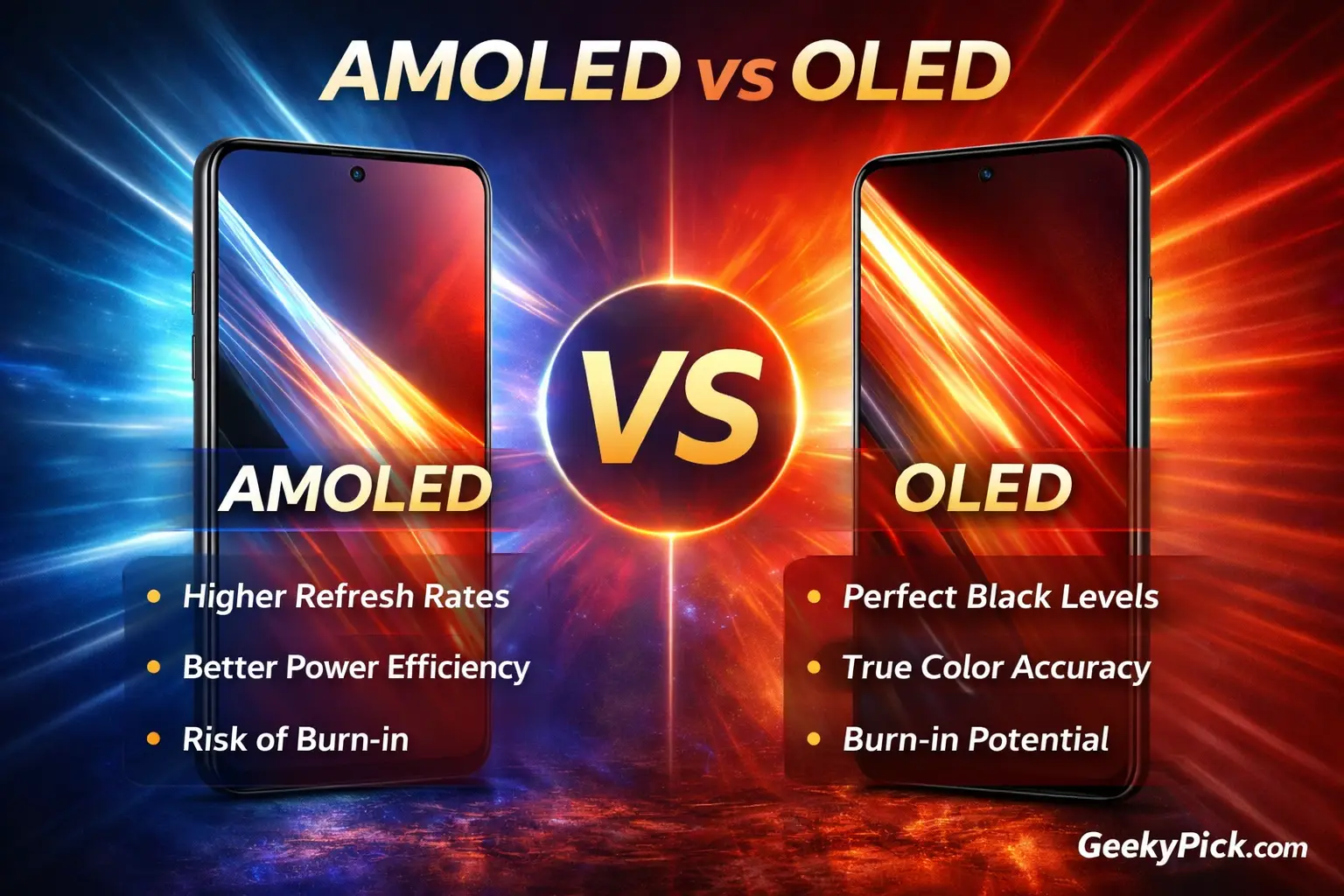
OLED stands for Organic Light Emitting Diode. In OLED displays, each pixel emits its own light when electricity passes through it. This eliminates the need for a backlight, allowing for true blacks and excellent contrast.
OLED panels are known for:
- Perfect black levels
- High contrast ratios
- Wide viewing angles
- Accurate color reproduction
What Is AMOLED?
AMOLED stands for Active Matrix Organic Light Emitting Diode. It is an advanced version of OLED that uses an active matrix of thin-film transistors (TFTs) to control each pixel individually.
This active matrix allows for faster refresh rates, better power efficiency, and improved performance in high-resolution displays.
Performance & Memory Impact
Displays themselves do not consume memory, but they influence overall device performance. AMOLED displays are optimized to work seamlessly with high-refresh-rate panels such as 90Hz, 120Hz, and even 144Hz.
OLED panels are excellent for static content and cinematic visuals, while AMOLED excels in fast-moving UI interactions, animations, and gaming.
Connectivity & Compatibility
Both AMOLED and OLED displays are compatible with modern connectivity standards such as HDMI, DisplayPort, USB-C Display Output, and wireless display technologies. There is no major difference in connectivity support between the two.
Camera & Audio Experience
While displays do not directly affect camera hardware, AMOLED screens provide better real-time previews due to higher brightness and contrast. This helps users judge exposure, colors, and night shots more accurately.
For multimedia consumption, both OLED and AMOLED deliver excellent HDR performance, enhancing audio-visual immersion when paired with stereo speakers.
Software / OS / UI Experience
Modern operating systems like Android, iOS, and smart TV platforms are heavily optimized for OLED-based displays. AMOLED takes this a step further by enabling features like:
- Always-On Display
- Per-pixel UI animations
- Dark mode power savings
- Adaptive refresh rate
Gaming Performance
For gaming, AMOLED displays have a clear advantage. The active matrix allows faster pixel response times, reducing motion blur and ghosting.
- Smoother frame transitions
- Higher refresh rate support
- Better touch sampling integration
Battery & Power Consumption
One of the biggest advantages of both OLED and AMOLED displays is power efficiency when displaying dark content. Since black pixels are completely turned off, less power is consumed.
AMOLED is generally more power-efficient than standard OLED in smartphones due to better pixel-level control.
AI & Special Features
AMOLED displays work exceptionally well with AI-based enhancements such as:
- AI brightness adjustment
- Adaptive color temperature
- Content-aware display tuning
- Eye comfort and blue light reduction
Launch & Market Adoption
OLED technology was first commercialized in the early 2000s, while AMOLED gained widespread adoption with smartphones in the 2010s. Today, AMOLED dominates the premium smartphone segment, while OLED is widely used in TVs and professional displays.
Availability
OLED and AMOLED displays are globally available across devices. AMOLED panels are commonly found in smartphones and wearables, while OLED is more prevalent in televisions and monitors.
Price Comparison
| Display Type | Estimated Cost Impact |
|---|---|
| OLED | Lower to Medium |
| AMOLED | Medium to High |
Pros & Cons
| AMOLED Pros | AMOLED Cons |
|---|---|
| High refresh rate | More expensive |
| Better power efficiency | Risk of burn-in |
Final Verdict
If you are choosing between AMOLED and OLED, AMOLED is generally the better option for smartphones, gaming, and daily usage due to its performance and efficiency. OLED remains an excellent choice for TVs and professional displays.
You May Get Intesrested
- Intel Lunar Lake
- Easy Ways to Run iphone Faster
- Best 5G Smartphones Under 50K Rupees
- Android Phones can Challenge iphone 16
FAQs
Is AMOLED better than OLED?
Yes, AMOLED is an advanced version of OLED and offers better performance.
Does AMOLED consume less battery?
Yes, especially when using dark mode or Always-On Display.
Is OLED bad for gaming?
No, but AMOLED performs better due to faster refresh rates.
Can OLED screens suffer burn-in?
Yes, both OLED and AMOLED can experience burn-in over time.
Which display is better for smartphones?
AMOLED is generally preferred for smartphones.